


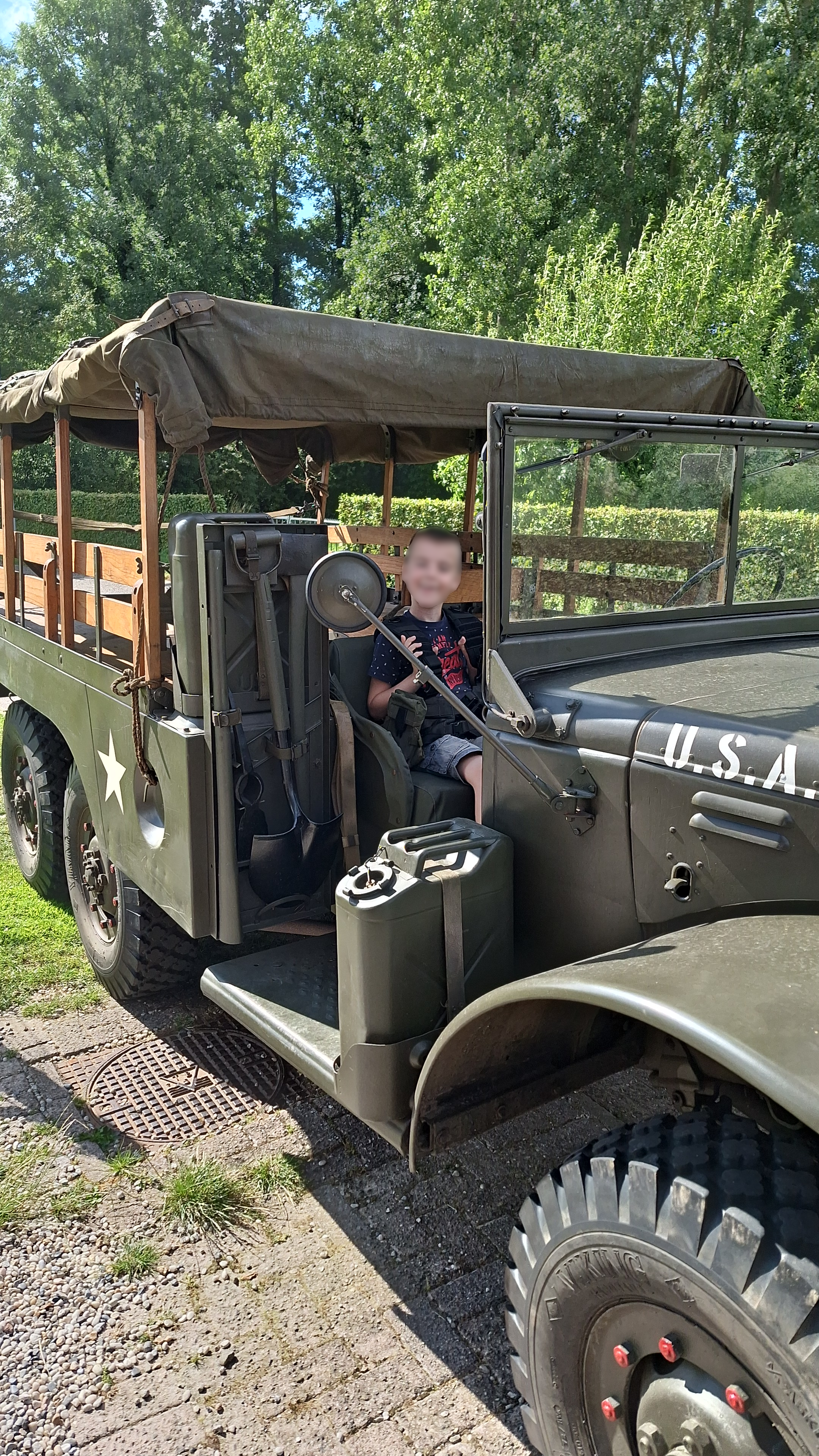
My son already knows what he wants to do when he gets his driving licence: he wants to drive my military Dodge.
As a father and a classic-car enthusiast, this makes me proud. The idea of handing him the steering wheel one day is something I genuinely look forward to. Not because I expect him to become as obsessed with old vehicles as I am, but because there is something special about passing a car from one generation to the next.
There is just one problem. He probably won't be taking his driving test for another ten years. And when I look at how quickly the automotive world is changing, I have started wondering whether getting his license and driving my Dodge will still be as straightforward as it sounds today.
The Dodge isn't going electric. It isn't getting an automatic gearbox. It isn't going to acquire lane-keeping assistance, intelligent speed assistance or automatic emergency braking. It will still have its clutch pedal, its manual gearbox and an engine that expects the person behind the wheel to know what they are doing.
The question is whether my son will still have the opportunity to learn.
Learning to drive is changing
For someone learning to drive today, an automatic car is becoming an increasingly attractive choice. Electric vehicles make the decision even easier. There is no clutch, no conventional gearbox and no need to coordinate clutch, throttle and gear changes while trying to concentrate on traffic.
For a learner, that can remove a significant part of the initial workload.
For a driving school, there are good reasons too. Electric and automatic cars can be easier to operate, and modern EVs require less of the conventional mechanical maintenance associated with combustion-engine cars. As the new and used-car markets fill with automatic vehicles, driving schools also update their car park.
So why would a driving school continue to keep a manual car?
For the customer who specifically wants a manual licence, there is obviously a reason. But if fewer and fewer students ask for manual lessons, the economics become increasingly difficult to justify.
And this is where the wider move towards electric company cars becomes relevant.
The 12% levy and the automatic-car effect
From 1 January 2027, the Netherlands will introduce a 12% pseudo-final levy on qualifying fossil-fuel passenger cars and vans made available by employers to employees for private use. The levy is paid by the employer and is explicitly intended to accelerate the electrification of business fleets.
My military Dodge is obviously not affected. It isn't a company car and nobody is going to send me a tax bill because I take it out for a Sunday drive. But I don't think the measure should be considered in isolation.
If more companies move towards electric company cars, more employees become accustomed to driving EVs and therefore automatics. Those vehicles eventually make their way into the second-hand market. That creates an increasingly attractive supply of automatic cars for private buyers.
As such it becomes a chain reaction. More EVs and automatics in company fleets create more automatics in the used-car market. More affordable automatic cars make it easier for young people to choose an automatic. While driving schools update their fleets due to regulations. More automatic driving-school cars mean more young people learn in automatics.
And once that happens, fewer people need to learn how to drive a manual. Nobody has to ban the manual gearbox. The market can simply make it less and less common.
What happens to the manual driving licence?
This is where Code 78 becomes important! Under the new EU Driving Licence Directive, a candidate who takes the practical driving test in an automatic vehicle receives the corresponding automatic-transmission restriction. Code 78 means that the licence is restricted to vehicles with automatic transmission. To drive a manual vehicle, the new directive requires a dedicated manual test or allows a dedicated training route, with the training route including at least seven hours of practical training.
That makes sense. If you have only demonstrated that you can drive an automatic, there is a reasonable argument that you haven't demonstrated that you can operate a manual gearbox safely.
But now imagine this situation ten years from now. My son goes to a driving school and wants to learn to drive. The instructor puts him in an electric car because that is what the school uses. He learns without a clutch and without changing gears. He passes his test and gets his licence with Code 78.
Then he comes home and says: "Dad, can I drive the Dodge?" And I have to tell him that knowing how to drive an automatic isn't enough.
Of course, I can teach him. I can explain the clutch. I can teach him how to find the biting point. I can show him how to change gear without making the engine sound like it is being punished. I can teach him how to reverse, pull away on a hill and listen to what the engine is telling him. But my driveway isn't a driving school.
If he needs professional manual training or a manual test to remove the restriction from his licence, there has to be somewhere he can do it.
And that is the part that makes me wonder. Will there still be enough driving schools offering manual training?
A problem that doesn't need a ban
The interesting thing about the future of manual cars is that nobody necessarily needs to outlaw them for them to become difficult to use. Imagine the progression:
- Fewer manual cars are sold;
- More people buy automatics;
- Driving schools buy automatics because that is what the politicians and customers want;
- Fewer young people learn to drive manuals;
- Manual lessons become a specialist service;
- Fewer driving schools offer them.
Eventually, a young enthusiast who wants to drive a classic manual car has to actively search for somewhere to learn. If any driving school left.
The cars are still legal, the manual gearbox still works, the classic car is still sitting in the garage. But the knowledge and infrastructure required to use it have become much less common. That is a very different problem from a ban. And, in some ways, a more interesting one.
The cars we leave behind
We've written about Code 78 before here at Vintage Wheels Collective, including the question of whether our children and grandchildren will still be able to drive the classic cars we leave behind. This article isn't intended to repeat that discussion.
This time, the question is personal. My son wants to drive my Dodge. That changes the way I look at it. When we talk about "future generations", it is easy to make the subject sound abstract. But when you imagine your own child sitting behind the wheel of your car, it becomes much more tangible.
I don't need him to become a classic-car collector. He doesn't have to spend his weekends searching for parts or reading old workshop manuals. He doesn't even have to love the Dodge as much as I do. I simply want him to have the choice. If he wants to drive it, I want him to be able to learn.
Because classic cars are meant to move
Perhaps this is what bothers me most about the gradual disappearance of manual driving. A classic car isn't just an object. We spend an enormous amount of time preserving the physical things: original engines, correct parts, paintwork, wheels, interiors and documentation. All of that is important.
But there is another part of preservation that is much harder to put in a display cabinet. The knowledge of how to use the car, the feel of a clutch the sound of an engine at the right revs, knowing when to change gear. Understanding what an old vehicle is telling you through the steering wheel, pedals and engine. Those things are part of the experience too.
And once that knowledge disappears, restoring the car alone doesn't bring it back. That is why I want my son to learn. Because there is something about being directly involved with a machine that is worth experiencing.
A new chapter for Vintage Wheels Collective
That idea is also part of why our new Vintage Wheels Collective website feels like an important step. We've recently restyled the site, but the biggest change isn't the appearance. The blogs are now finally becoming the main focus. That feels right because, for us, the cars have always been about more than the cars themselves. It's about the people who own them, restore them and drive them. It's about the memories attached to them, the engineering behind them and the culture that grew around them.
And it is also about what happens when that culture changes. We don't want Vintage Wheels Collective simply to be a place where we say that everything was better in the past. That isn't true, and it isn't particularly interesting. Instead, we want to document why these vehicles still matter.
Why somebody would rather take a classic car for a Sunday drive than take the modern car.
Why a manual gearbox can make driving feel like an activity rather than simply transportation.
Why people spend countless hours keeping machines alive that are decades older than they are.
And why we want the next generation to have the opportunity to experience them.
And now there may be a soundtrack
Somewhere along the way, a friend of ours had another idea. Why not make an EP about it? Songs about classic cars disappearing from the roads. About manual gearboxes. About Code 78. About a generation that may grow up never having learned what it feels like to operate a clutch.
At first, it sounds like a slightly strange subject for a collection of songs. But the more we talked about it, the more we liked it.
An article can explain legislation. It can explain why driving schools prefer automatic cars and why EVs are accelerating the change. It can explain the difference between an automatic and manual licence.
Music can capture the feeling. The sound of an old engine, the memory of learning to drive, the frustration of stalling, the satisfaction of getting a perfect gear change. And perhaps the slightly surreal thought of one day having a beautiful old manual car sitting in your garage while your son needs specialist training before he can legally drive it.
That is a story worth telling in another way.
I don't want to stop the future
None of this means I want to stop the transition to electric vehicles. I understand why governments encourage it, why companies adopt it and why consumers increasingly choose EVs. I also understand why modern driver-assistance systems are being introduced. The EU's General Safety Regulation has already made a range of assistance and safety technologies mandatory on new vehicles, including systems such as intelligent speed assistance, reversing detection, driver attention warnings, lane-keeping systems and automated braking.
Although I'm personally not a fan, my objection isn't to any of that. What I don't want is for progress to remove choice.
If my son wants to drive an electric car, great. If he wants an automatic, that's fine. But if he wants to drive Dad's Dodge, I want there to be a way for him to learn how. That doesn't seem like an unreasonable thing to preserve.
Maybe one day
Ten years is a long time, particularly in the automotive world. By the time my son takes his driving test, regulations may have changed again. The driving-school industry may look completely different. Electric vehicles may be even more dominant than we expect today. Perhaps manual driving will have become a specialist skill.
Or perhaps the industry will have found a sensible way to keep manual training readily available for those who want it.
I have no idea. But I know what I would like to see.
- One day my son gets his driving licence.
- I let him sit behind the wheel.
- He pushes the start pedal down and starts the engine.
- I sit beside him.
- He selects first gear. He lets the clutch out too quickly.
- The Dodge gives him a little reminder that old cars have their own opinions.
- We laugh.
- He tries again.
- And eventually we are driving.
- Maybe, many years later, he will have children of his own. Maybe the Dodge will still be around. Maybe one of them will sit behind that same steering wheel and ask him how the clutch works.
That is the future I would like. A world where moving forward doesn't mean leaving everything behind.
Because a classic car isn't truly preserved when it is only kept. It is preserved when somebody still knows how to start it, select a gear, feel the clutch bite and take it down the road.
And if that somebody happens to be my son, I think I'll be rather happy to hand him the keys.
The Ghosts of the Open Road T-shirt is available in our store

